



A sharp knife is one of the most important tools in any kitchen or outdoor kit. Yet many people continue using dull knives without realizing how much performance they are losing. Learning how to sharpen a knife properly not only restores cutting performance but also extends the life of your knife.

Complete guide to whetstones (Shapton Kuromaku)
Why whetstones are the best way to sharpen knives
There are many knife sharpeners available today, but professional chefs and knife makers overwhelmingly prefer whetstones. The reason is control.
A sharpening stone allows you to control:
- Sharpening angle
- Pressure
- Steel removal
- Final edge finish
This preserves the geometry of the knife and produces a sharper, longer lasting edge than most mechanical sharpeners.
Understanding sharpening stone grit
Sharpening stones are classified by grit number, which describes the size of the abrasive particles. Lower numbers remove steel faster. Higher numbers refine the edge.
General grit categories:
200–500 grit
Coarse stones used for repair and heavy sharpening.
800–1500 grit
Medium stones used for regular knife sharpening.
2000+ grit
Fine stones used for refining and finishing an edge.
A complete sharpening progression typically moves from coarse → medium → fine.
Shapton Kuromaku, professional Japanese sharpening stones
Shapton is one of Japan’s most respected manufacturers of sharpening stones. The Kuromaku series is widely used by professional chefs, knife makers and sharpening specialists. These stones are known for several advantages:
• Very fast cutting performance.
• Hard ceramic structure.
• Long lasting flatness.
• Excellent feedback while sharpening.
• Splash-and-go convenience.
Unlike traditional soaking stones, Kuromaku stones do not require soaking. Simply add water and start sharpening. Each stone also comes in a protective storage case that doubles as a sharpening base, making them practical both in the kitchen and in the workshop.

Shapton Kuromaku #320 – Coarse sharpening stone
The #320 grit stone is designed for heavy edge work and repairs. It is used when a knife has:
- Chips in the edge.
- A rounded edge.
- Severe dullness.
- Incorrect bevel geometry.
Because of its aggressive cutting ability, the #320 removes steel quickly and restores the basic shape of the edge before moving to finer stones.
Typical uses:
- Repairing damaged knives.
- Resetting bevel angles.
- Restoring heavily worn edges.
This is the first step when serious sharpening is required.

Shapton Kuromaku #1000 – The most versatile sharpening stone
The #1000 grit stone is the workhorse of the sharpening process.
It is ideal for:
- Regular knife maintenance.
- Restoring dull kitchen knives.
- refining the edge after coarse sharpening.
The #1000 grit creates a clean scratch pattern that produces a sharp and durable working edge suitable for daily kitchen or outdoor use.
If you only own one sharpening stone, the #1000 grit is usually the best choice.

Shapton Kuromaku #2000 – Fine sharpening stone
The #2000 grit stone refines the edge after medium sharpening.
Its purpose is to:
- Remove the scratch pattern left by #1000.
- Smooth the edge.
- Improve cutting control and slicing performance.
The result is a refined edge that balances sharpness and durability, making it ideal for kitchen knives and precision cutting tasks.
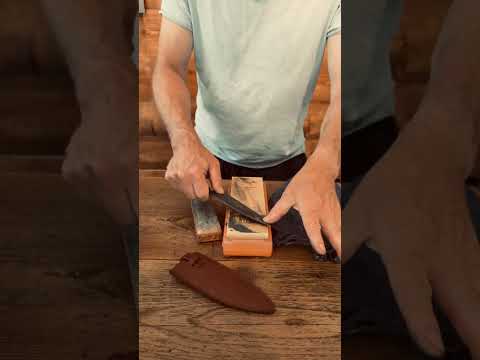
Step-by-Step: How to sharpen a knife with a whetstone
Sharpening on a whetstone is simpler than many people think. The key is maintaining a consistent angle and working methodically.
Step 1 - Prepare the stone
Shapton Kuromaku stones are splash-and-go. Simply:
- Place the stone on a stable surface.
- Add water to the surface.
- Ensure the stone does not move.
Step 2 - Find the sharpening angle
Most kitchen knives are sharpened between 15–20 degrees. A practical method is to:
- Place the knife almost flat on the stone.
- Slightly raise the spine until the edge contacts the stone.
Consistency matters more than perfect precision.
Step 3 - Sharpen along the edge
Move the knife along the stone using smooth strokes. Work from:
heel → middle → tip
Use moderate pressure and allow the abrasive surface to remove steel gradually.
Step 4 - Raise a burr
Continue sharpening until you feel a small burr along the opposite side of the edge. The burr indicates the edge has been fully sharpened on that side. Then repeat the process on the other side of the knife.
Step 5 - Progress to finer stones
After shaping the edge:
- Start with #320 if major repair is needed.
- Refine the edge with #1000.
- Finish with #2000.
Each stone removes the scratches from the previous grit and improves the edge.
Step 6 - Final refinement
Finish with very light strokes to remove the remaining burr. Some users also strop the knife on leather for maximum sharpness.
Discover the Shapton Collection
-
Shapton Kuromaku #320, coarse sharpening stone
Regular price € 55Regular priceUnit price per -
Shapton Kuromaku #1000, medium sharpening stone
Regular price € 55Regular priceUnit price per -
Shapton Kuromaku #2000, fine sharpening stone
Regular price € 64Regular priceUnit price per -
Shapton Kuromaku sharpening set, 3 stones (#320, #1000, #2000)
Regular price € 156Regular priceUnit price per